NFL Trades Work: Rules, Salary Caps & Draft Capital Explained 2026
The Ultimate Guide to NFL Trades: Rules, Strategies, and Blockbuster Deals
Few notifications light up a football fan’s phone quite like breaking news of a blockbuster NFL trade. In a matter of seconds, a struggling franchise can secure its quarterback of the future, or a Super Bowl contender can acquire the missing defensive piece needed to secure a championship.
Unlike other professional sports leagues where trades happen constantly and casually, NFL trades carry immense weight. Football is a sport of complex offensive and defensive schemes, hard salary caps, and a massive 53-man roster. Integrating a new player mid-season is difficult, and the financial ramifications of a trade can tie up a team’s checkbook for years. Yet, the modern NFL has seen an explosion in aggressive trade activity, driven by general managers who view draft picks and salary cap space as fluid assets.
If you have ever wondered why a superstar is traded for a seemingly low draft pick, or why a team takes a massive financial hit just to move a player off their roster, you need to look under the hood of front-office operations. Here is exactly how NFL trades work, the financial rules that govern them, and the strategies that turn general managers into legends.
Understanding the Mechanics of NFL Trades
An NFL trade is not as simple as two teams agreeing to swap players. Every transaction must adhere to strict league bylaws, be approved by the NFL front office, and fit within the tight constraints of the league calendar.
The NFL Trade Deadline: Rules and Recent Changes
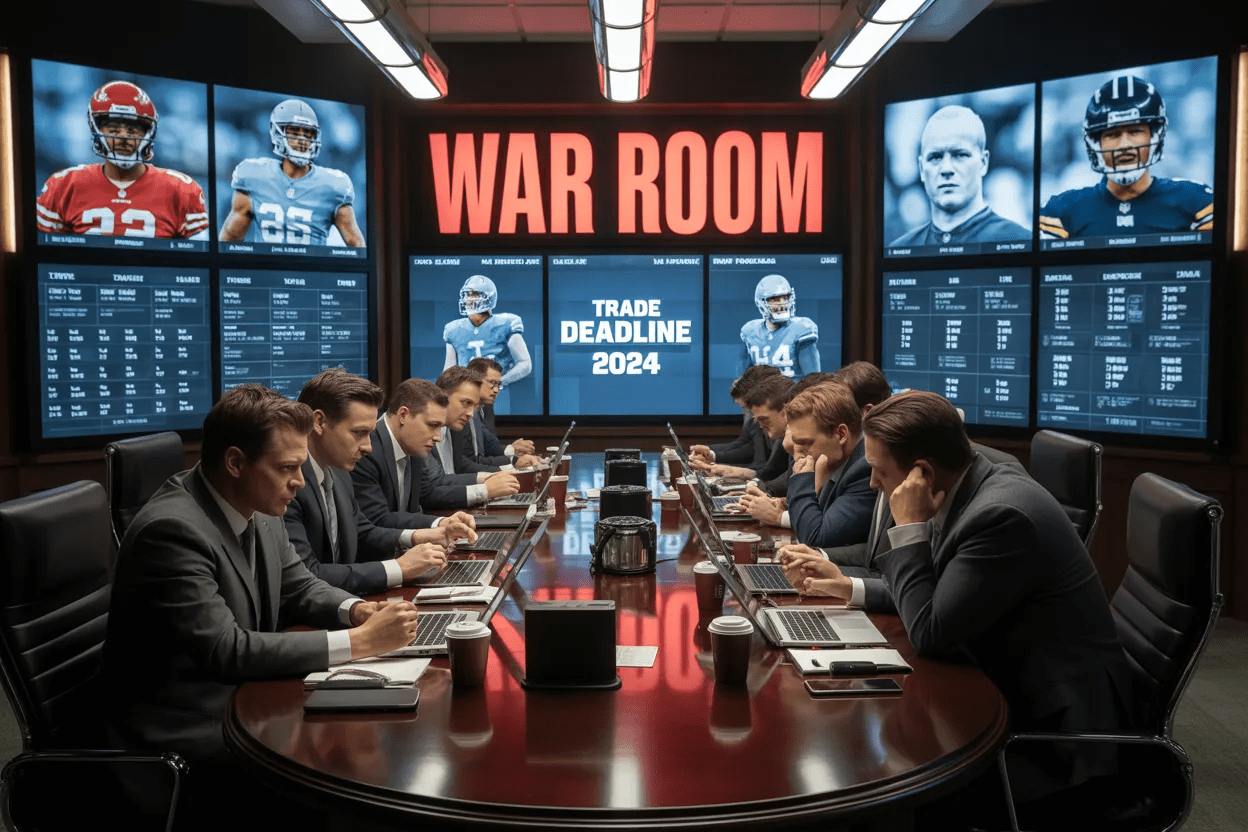
The NFL trade deadline is the final day during the regular season that teams can exchange players. For decades, this deadline fell on the Tuesday following Week 8 of the regular season. However, recognizing that a 17-game season requires more flexibility, NFL owners voted in 2024 to push the deadline back to the Tuesday following Week 9.
Once the deadline passes, teams can no longer trade players to one another. If a team wants to get rid of a player after the deadline, their only option is to release them outright. That player is then subject to the waiver wire, where other teams can claim their existing contract. Trading is only permitted to resume at the start of the new league year in March.
Who Can Be Traded (and Who Can’t)?
In theory, any player under contract can be traded. However, certain restrictions apply. A player who has been placed on injured reserve (IR) can be traded, but the acquiring team must accept the medical risk. Free agents cannot be traded because they are not under contract.
Furthermore, players operating under the Franchise Tag present unique situations. A player who has signed their franchise tender can be traded, but if they haven’t signed the tender, they are technically not under contract and cannot be moved until they put pen to paper.
No-Trade Clauses and Player Leverage
Unlike the NBA or MLB, where no-trade clauses are relatively common for top-tier stars, they are exceedingly rare in the NFL. Because NFL contracts are largely non-guaranteed, teams are hesitant to give players total control over their movement.
When a player does possess a no-trade clause, it gives them immense leverage. They can veto any trade to a city they do not want to live in, or to a team with a coaching staff they do not respect. This effectively forces the general manager to work collaboratively with the player and their agent to find a suitable trade partner, often resulting in a lower return in draft compensation because the bidding war is artificially restricted.
The Currency of the League: Draft Picks and Player Valuation
While player-for-player trades happen, they are incredibly rare. Finding two players of equal value who fit the specific schematic and financial needs of two different teams is like catching lightning in a bottle. Instead, the primary currency of the NFL trade market is draft picks.
The Jimmy Johnson Trade Value Chart
In the late 1980s, Dallas Cowboys head coach Jimmy Johnson revolutionized the league by creating a point-value chart for NFL draft picks. He assigned a numerical value to every single pick in the seven-round draft. The 1st overall pick was worth 3,000 points. The 16th overall pick was worth 1,000 points. The final pick in the 7th round was worth 2 points.
This chart allowed general managers to mathematically quantify trades. If a team wanted to trade up to the 5th overall pick (1,700 points), they knew they had to package their own 1st-round pick and a combination of 2nd or 3rd-round picks that equaled roughly 1,700 points.
While modern analytics departments have created updated, more scientifically accurate value charts (often called the Rich Hill chart or the Fitzgerald-Spielberger chart), the underlying concept remains the foundation of NFL trade negotiations. GMs use these charts to determine exactly what a veteran player is worth in draft capital.
Conditional Draft Picks Explained
Evaluating a player’s worth is subjective, especially when dealing with injuries, inconsistent performance, or age. To bridge the gap in negotiations, teams frequently use conditional draft picks.
A conditional pick is a draft choice that changes in value based on the player’s performance with their new team. For example, Team A might trade a quarterback to Team B for a 3rd-round pick. However, the condition states that if the quarterback plays 65% of the offensive snaps and leads Team B to the playoffs, that 3rd-round pick upgrades to a 1st-round pick. This protects the acquiring team from giving up premium draft capital if the player gets injured or underperforms, while giving the selling team a chance at a massive return if the player excels.
Swapping Players vs. Hoarding Picks
Teams value draft picks because they represent cost-controlled labor. A rookie drafted in the 1st round is locked into a relatively cheap four-year contract, with a team option for a fifth year. In a salary-capped league, hitting on draft picks allows a team to spend their money elsewhere on high-priced veteran free agents. Therefore, a team in a rebuilding phase will gladly trade away an expensive 28-year-old star in exchange for multiple draft picks, resetting their financial clock and building for the future.
The Financial Side: Salary Caps and Dead Money
You cannot understand NFL trades without understanding the salary cap. The cap is a hard spending limit enforced by the league, and every single dollar exchanged in a contract must be accounted for.
How Trades Impact the Salary Cap
When a player is traded, their contract goes with them, but the financial burden is split. The new team inherits the player’s base salary and any roster bonuses moving forward. The old team, however, remains responsible for the signing bonus they already paid the player.
Here is why that matters: When an NFL team gives a player a $20 million signing bonus on a four-year contract, they hand the player a $20 million check on day one. But for salary cap purposes, the NFL allows the team to spread that cap hit out evenly—$5 million per year for four years.
The “Dead Money” Dilemma
If that team trades the player after year one, they have three years of prorated signing bonus ($15 million) that has not yet hit their salary cap. The NFL rules dictate that if a player is traded, all of that remaining prorated money accelerates and hits the current year’s salary cap immediately. This is called “dead money.”
Dead money is cap space taken up by a player who is no longer on the roster. If a team trades a superstar with a massive signing bonus, they might incur $30 million or more in dead money. This is the primary reason why some seemingly obvious trades never happen—the team simply cannot afford the cap acceleration penalty to get the player off the books.
Retained Salary: A Growing Trend
Historically, the acquiring team absorbed all base salary obligations. However, modern NFL trades increasingly mimic the NHL or MLB, where the trading team agrees to pay a portion of the player’s salary to facilitate the deal. If a team desperately wants to acquire draft picks for an underperforming, highly-paid veteran, they will convert his base salary into a signing bonus before the trade, paying it out of their own pockets. The acquiring team then gets the player at a heavily discounted rate, and in return, they surrender a higher draft pick.
Strategic Reasons Why NFL Teams Make Trades
Every trade requires a buyer and a seller. The motivations of each side depend entirely on their current competitive timeline.
The “All-In” Push for a Super Bowl
When a general manager believes their team is one or two pieces away from winning a Super Bowl, they will adopt an aggressive, win-now strategy. They will willingly trade future 1st and 2nd-round draft picks to acquire elite, proven veterans. The logic is simple: the ultimate goal is a championship, and maximizing a brief championship window is worth the cost of future drafts. They are trading unknown future potential for guaranteed present production.
Rebuilding and Accumulating Draft Capital
On the opposite end of the spectrum are the sellers. When a team realizes their roster is not competitive, keeping an aging, expensive veteran serves no purpose. That player’s prime years will be wasted on a losing team. General managers in this position will conduct a “fire sale,” trading away their most valuable assets to stockpile draft picks. This allows them to draft a new young core and clears expensive contracts off their salary cap, giving them immense financial flexibility two or three years down the road.
Contract Disputes and Disgruntled Stars
Sometimes, a trade is forced by a breakdown in relationship. If a superstar outplays their contract and demands a new, market-resetting extension, the team may simply refuse or lack the cap space to pay them. The player may “hold out” of training camp, refusing to play. To avoid a toxic locker room environment and get some value in return, the team will trade the player to a franchise willing to meet their financial demands.
The Most Impactful NFL Trades in History
To truly grasp the power of the trade market, one must look at the deals that fundamentally altered the landscape of the league.
The Herschel Walker Trade: Blueprint for a Dynasty
In 1989, the Dallas Cowboys traded star running back Herschel Walker to the Minnesota Vikings in what remains the most lopsided and consequential trade in NFL history. The Vikings believed Walker was the final piece for a Super Bowl run. The Cowboys, deeply in a rebuild, sent Walker and a handful of picks to Minnesota in exchange for five players and a staggering six draft picks (including three 1st-rounders and three 2nd-rounders).
Dallas used those draft picks to select legendary players like Emmitt Smith and Darren Woodson, building the foundation of a dynasty that won three Super Bowls in the 1990s. The trade proved that hoarding draft capital could single-handedly rebuild a franchise.
The Rams’ “F*** Them Picks” Era
Under General Manager Les Snead, the Los Angeles Rams operated with total disregard for early-round draft picks. They famously went seven consecutive years without making a 1st-round selection, trading them away to acquire proven superstars like Jalen Ramsey, Von Miller, and Matthew Stafford. The strategy culminated in a victory in Super Bowl LVI. The Rams proved that draft picks are highly overrated if you can successfully flip them for elite, top-tier talent that puts you over the championship hump.
The Russell Wilson Blockbuster: A Modern Cautionary Tale
In 2022, the Denver Broncos traded two 1st-round picks, two 2nd-round picks, and three players to the Seattle Seahawks for quarterback Russell Wilson. Denver then handed Wilson a massive $245 million contract extension before he even played a game. The trade was a disaster. Wilson struggled mightily in Denver’s system, and the Broncos released him just two years later, incurring an unprecedented $85 million in dead money cap penalties. It stands as a stark warning of the catastrophic risk involved when trading premium assets for an aging quarterback.
How Modern General Managers Approach the Trade Market
The modern NFL front office is vastly different from the conservative regimes of the 1990s and 2000s. Today, general managers treat their rosters like stock portfolios.
The Shift Toward Aggressive Roster Building
General managers like Howie Roseman of the Philadelphia Eagles have popularized a philosophy of constant movement. They treat draft picks as liquid currency. If a position group is weak mid-season, they do not wait for the offseason to fix it; they aggressively work the phones before the trade deadline.
Furthermore, modern GMs are much more willing to swallow dead money. In the past, front offices were paralyzed by the fear of salary cap penalties. Today, GMs view dead money as the necessary cost of doing business and correcting mistakes quickly. It is better to take a massive cap hit for one year and clear the books than to keep a disgruntled or underperforming player on the roster simply because you already paid them.
Conclusion
NFL trades are complex ecosystems of salary cap math, draft pick valuation, and risk assessment. They are the ultimate gamble. When executed perfectly, a trade can be the catalyst for a decade of dominance or the final puzzle piece in a Super Bowl run. When executed poorly, it can result in crushing salary cap debt and the loss of critical future draft capital.
As the league continues to evolve with higher salary caps and more analytically driven front offices, the trade market will only become more aggressive. Understanding the mechanics behind these moves gives fans a clearer, deeper appreciation of the high-stakes chess match played every day by NFL general managers.