What Does Bugbear Meaning? Origins, Usage & Folklore
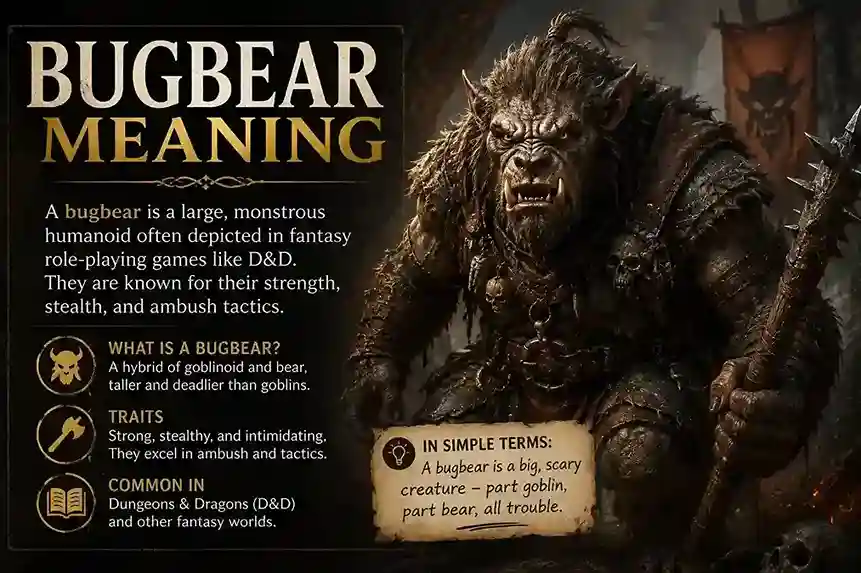
At its simplest, the bugbear meaning points to an object of exaggerated fear or intense dislike. Dictionaries define it as a cause of obsessive anxiety, a persistent annoyance, or something that provokes needless terror. Far more than a minor pet peeve, a bugbear lodges in the mind and amplifies worry.
The modern noun carries two primary shades:
- An imaginary creature used to frighten children.
- A continual source of dread or irritation in adult life.
In both senses, the bugbear meaning centers on irrational or disproportionate fear. A looming deadline, an uncomfortable conversation, or an old superstition can all become a bugbear once they occupy more mental space than they deserve.
Etymology: Where Did the Term Bugbear Come From?
The word blends two old elements: bug (a hobgoblin or terrifying specter) and bear. In Middle English, a “bugge” was a frightening creature, closely related to the Welsh bwg (ghost) and the Scottish bogill. The bear part likely reinforced the image of a hulking, menacing beast.
According to the Oxford English Dictionary, the first known use of “bugbear” dates to the 1550s, appearing as bugge-beare. By the late 16th century, it described both a scary goblin and any object of baseless fear. Over time, the bugbear meaning shed its strictly monstrous skin and entered the realm of everyday frustrations.
Quick Fact Table: Bugbear Etymology
| Time Period | Term Form | Meaning |
|---|---|---|
| 14th century | Bugge | Hobgoblin, terrifying spirit |
| 1550s | Bugge-beare | Imaginary monster; figurative dread |
| Early 1600s | Bugbear | Something feared without reason |
| 1800s–Present | Bugbear | Persistent irritation, anxiety trigger |
Bugbear in Folklore and Mythology
In the folklore of Britain and Northern Europe, bugbears were shape‑shifting goblins that lurked in shadowy woods or under beds. Parents warned misbehaving children that a bugbear would snatch them, a practice echoed by the bogeyman tradition.
Key folkloric traits include:
- A large, hairy form, often with glowing eyes.
- The ability to vanish and reappear at will.
- A taste for frightening rather than physically harming humans.
- A connection to nightmares and sleep paralysis.
Scholars of mythology, such as those cited in Encyclopædia Britannica, note that bugbears belong to a wide family of household and wilderness goblins — alongside boggarts, hobgoblins, and brownies. The specific bugbear meaning, however, always leaned toward fear‑mongering, making it a psychological tool as much as a supernatural one.
Bugbear vs. Bogeyman: What Sets Them Apart
Though used interchangeably at times, a bugbear and a bogeyman are not identical. The distinction matters when you want to capture the exact bugbear meaning.
- Bugbear: Originally a tangible goblin figure that later became any overwhelming dread or annoyance. In modern use, it typically lives in the mind rather than under the bed.
- Bogeyman: A more generic monster figure with no fixed shape, deployed almost exclusively to frighten children into obedience.
You can have a bugbear about public speaking, but you would not call that a bogeyman. The bugbear meaning now thrives in the abstract, while the bogeyman remains a nursery threat.
The Bugbear as a Metaphor for Everyday Anxieties
Today, you are far more likely to encounter the bugbear meaning in a boardroom than a bedtime story. It functions as a powerful metaphor for the worries that balloon out of proportion.
Common metaphorical bugbears include:
- Fear of rejection
- Imposter syndrome
- Health anxiety triggered by minor symptoms
- Inbox dread on Monday morning
- Perfectionism that stalls progress
Calling a fear a bugbear acknowledges its exaggerated nature. It gently reminds you that the monster is partly of your own making — and therefore one you can tame.
In fantasy games and Dungeons & Dragons, Bugbear
Role‑playing games have given the bugbear a new, vivid body. In Dungeons & Dragons, bugbears are large, hairy goblinoids that possess greater strength and cunning than their lesser brethren.The Monster Manual describes them as ambush predators with a gift for sudden violence.
D&D bugbear characteristics at a glance:
- Size: Medium to large humanoid
- Alignment: Chaotic evil
- Notable traits: Brute force, surprising stealth, darkvision
- Common role: Mercenary, raider, dungeon guardian
This fantasy incarnation reconnects the bugbear meaning with its physical, beastly roots while adding layers of strategy and narrative — a favourite for game masters who want an enemy both brutish and cunning.
How to Use Bugbear in Modern Sentences
Mastering the bugbear meaning means knowing how to slide it into everyday conversation. The word works as a countable noun, often preceded by a possessive or an article.
Examples that show natural usage:
- “My biggest bugbear is people who chew loudly in meetings.”
- “Uncertainty about the future became a daily annoyance for her.”
- “Even though he consistently passed, he viewed the quarterly audit like a bugbear.”
- “The team’s collective bugbear was the outdated software that crashed twice a day.”
In each case, the bugbear is not a life‑threatening terror but a drain on comfort and focus — exactly the modern meaning.
Common Synonyms and Related Terms for Bugbear
No single synonym captures the entire bugbear meaning, but several come close depending on context.
- Pet peeve – a minor, specific annoyance (lighter than a bugbear)
- Bête noire – a person or thing one particularly dislikes (French for “black beast”)
- Hobgoblin – a mischievous goblin; also a source of fear
- Bogey – an evil spirit or something that causes worry
- Specter – a haunting fear or mental image
- Obsession – when the bugbear dominates thoughts
Use pet peeve for trivial irritations. Reserve bugbear for the worries that genuinely unsettle you, even if the cause seems small.
The Psychological Dimension: Why We Create Bugbears
Psychologists recognise that people often construct mental bugbears to externalise anxiety. Naming an amorphous dread gives it boundaries. Suddenly, “the fear of failure” becomes a bugbear you can confront.
This externalisation serves a purpose:
- It transforms free‑floating anxiety into a named opponent.
- It reveals that the threat may not be proportional.
- It opens the door to cognitive reframing.
The bugbear meaning, then, doubles as a coping mechanism. When you label something a bugbear, you admit its power while questioning its right to control you.
Bugbear Meaning Across Cultures and Languages
Many languages have a word that mirrors the bugbear meaning. The concept of a fear‑spirit that mutates into a daily vexation is remarkably universal.
- German: Schreckgespenst (fright‑ghost) or Popanz (bogeyman, often a minor worry)
- Russian: Жупел (zhupel) – a bugbear, something used to scare people
- Japanese: 妖怪 (yōkai) can include bugbear‑like monsters, though the metaphorical use is less common
- Spanish: Coco or hombre del saco serve as child‑frighteners, but pesadilla recurrente (recurring nightmare) fills the metaphorical gap
These linguistic parallels highlight a shared human need: giving shape to shapeless fear. The English bugbear meaning does exactly that, with a uniquely old‑world flair.
Why Knowing the Bugbear Meaning Enriches Your Vocabulary
Understanding the full bugbear meaning sharpens your communication. It lets you name a specific psychological state — the point where annoyance festers into dread. Precision in language builds empathy and clarity.
Benefits of adding bugbear to your lexicon:
- You describe emotions with historical depth.
- You sound more articulate without being pretentious.
- You nudge others to examine their own exaggerated fears.
- You connect modern stress to centuries of storytelling.
When you call something a bugbear, you participate in a tradition that stretches from shadowy medieval forests to today’s therapy rooms.
Frequently Asked Questions (FAQ)
What is the simple definition of bugbear?
The bugbear meaning boils down to a source of persistent, often irrational fear or intense irritation. It can also refer to an imaginary goblin used to frighten children.
How is bugbear used in a sentence?
A natural sentence: “Long queues at the grocery store became her personal bugbear after a year of remote work.” The word fits wherever a nagging worry lives.
What’s the difference between bugbear and pet peeve?
A pet peeve is a mild, surface‑level annoyance. The bugbear meaning carries more weight — it suggests genuine anxiety or dread, not just mild dislike.
Where does the term bugbear originate from?
It originates from the Middle English “bugge” (hobgoblin) combined with “bear,” first recorded in the 1550s. It initially described a terrifying creature and evolved into a metaphor for irrational fears.
Can a bugbear be a person?
Yes. You can describe a domineering boss or a critical relative as your bugbear if they cause persistent unease. However, the modern bugbear meaning usually applies to a concept or situation rather than an individual.
Is bugbear still used in modern English?
Absolutely. While less common than “pet peeve,” it appears in British and American English, in journalism, literature, and everyday speech. Its rich history makes it a favourite among word enthusiasts.